Notice of Public Hearings on Proposed Adjustments to Water, Sewer, and Solid Waste Rates



Frequently Asked Questions
Proposed Adjustments to Water, Sewer, and Solid Waste Rates
1. Who can protest the sewer rates and why can’t everyone protest sewer rate increases?
Under Proposition 218, only property owners, or the legally responsible ratepayers (named on the BVCSD account), who receive sewer service, or have sewer service available to their parcel, may submit a written protest for sewer rates. Only 514 parcels receive sewer service. Customers who do not receive or do not have access to sewer service (i.e. parcels with their own septic systems) are not eligible to protest sewer rate adjustments.
2. Why is the District proposing a new multifamily sewer rate that is different from single family sewer rates?
Multifamily properties such as condominiums generate lower average sewer flows per dwelling unit compared to single family residences. The average single-family customer has 8 hundred cubic feet (HCF) of monthly sewer flow while the average multifamily customer has 6 HCF of monthly sewer flow. As a result, multifamily sewer rates are proposed to be lower than single family rates to reflect the lower use of the sewer system.
3. Why is the effluent rate different from regular water rates?
Effluent is recycled water produced at the District’s wastewater treatment plant. The effluent rate is based on the cost of treating wastewater divided by the total volume processed annually. Potable water is sourced from the Tehachapi-Cummings County Water District and the District’s wells and includes different treatment and supply costs. Because the costs of providing these services differ, their rates also differ.
4. How were the non-potable water rates determined? Why do non-potable rates exclude treatment costs?
The proposed water consumption rates were determined based on the cost of supply, transmission, and distribution of water to customers. All classes of water customers pay these costs. In addition, potable water requires treatment to meet drinking water standards, so the potable water rate also includes treatment costs. Non-potable water is only used for lakefill and does not require treatment. Proposition 218 requires rates to reflect the actual cost of providing service, so treatment costs are excluded from non-potable water rates since no treatment is provided.
5. Why didn’t adding a manure disposal charge lower solid waste rates for everyone else?
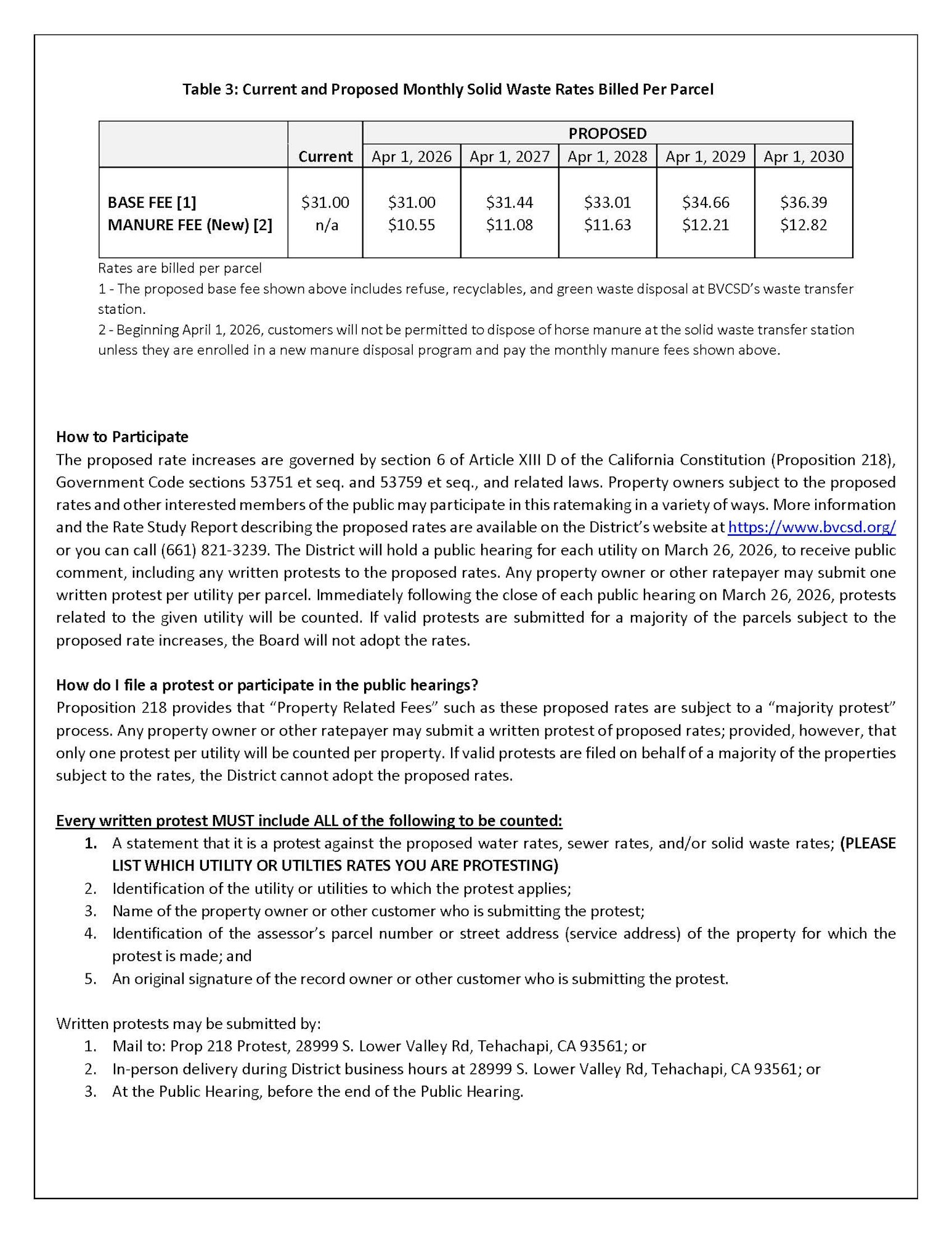
Solid waste costs are going up due to increasing regulatory requirements, disposal fees, and needed equipment and facility upgrades. Bear Valley Community Services District must also pay for improvements like repaving the transfer station for stormwater control and buying
equipment such as a backhoe and loader. Because of these rising costs, the base solid waste fee will stay at $31 per month starting April 1, 2026, and will gradually increase over time.
Proposition 26 requires that a government service provided to a specific customer (parcel), and not provided to others, can only be charged to those receiving that specific service and are limited to the cost of providing the service. The new manure disposal fee ensures that only customers (parcels) who use that service are charged for the service.
6. What is the District doing to keep the rates low and why is the District adjusting the rates now?
The District only adjusts rates when necessary to recover the cost of providing services. The District last adjusted water rates in January 2023, solid waste rates in February 2023, and sewer rates in January 2024. Current rate revenues are no longer sufficient to fully fund operating costs, required infrastructure improvements, and debt service for the water, sewer, and solid waste systems. The sewer fund and solid waste fund are currently operating at a deficit, and the water utility has significant deferred maintenance needs that must be addressed to maintain reliability and quality of service. The District prioritizes proactive maintenance to reduce the risk of costly emergency repairs and system failures.
7. Are the proposed residential rate increase comparable with other jurisdictions?
The District’s water rates are higher than many surrounding agencies due to the mountainous terrain and the infrastructure needed to pump water across elevation changes. The District’s sewer rates are higher than many surrounding agencies because the District serves a smaller customer base (economies of scale) – large infrastructure costs are spread over a small number of homes and businesses. Solid waste rates are generally comparable to nearby agencies, although the types and levels of service provided vary by jurisdiction. Additional comparative information is available in the rate study report posted on the District’s website.
8. How can I comment on the proposed rates?
You may provide comments to Board of Directors regarding the rates either in-person or by submitting written comments. The Board of Directors will hold a public hearing to consider the rate adjustment on Thursday, March 26, 2026, at 6:00 pm at the District’s office at 28999 S. Lower Valley Rd, Tehachapi, CA 93561. At the hearing, you may make verbal comments to the Board of Directors during the public comment period.
You may also submit a formal protest letter in opposition to the rate adjustment. You may mail or hand-deliver your written protest in advance of the public hearing to: Prop 218 Protest, 28999 S. Lower Valley Rd, Tehachapi, CA 93561. You may also hand-deliver your protest at the public hearing. Only written protests received prior to the conclusion of the hearing will be counted and only one protest per parcel will be counted. More details regarding how to submit a protest are included in the Notice of Public Hearing. If more than 50% of property owners or ratepayers submit protests, the Board of Directors cannot adopt the rate adjustment.
9. When would the new rates be effective?
If adopted by the Board of Directors, the new rates will become effective on April 1, 2026.