Golf Cart & Low-Speed Vehicle Frequently Asked Questions
1. What is the difference between a Golf Cart and a Low-Speed Vehicle (LSV) or Neighborhood Electric Vehicle (NEV)?
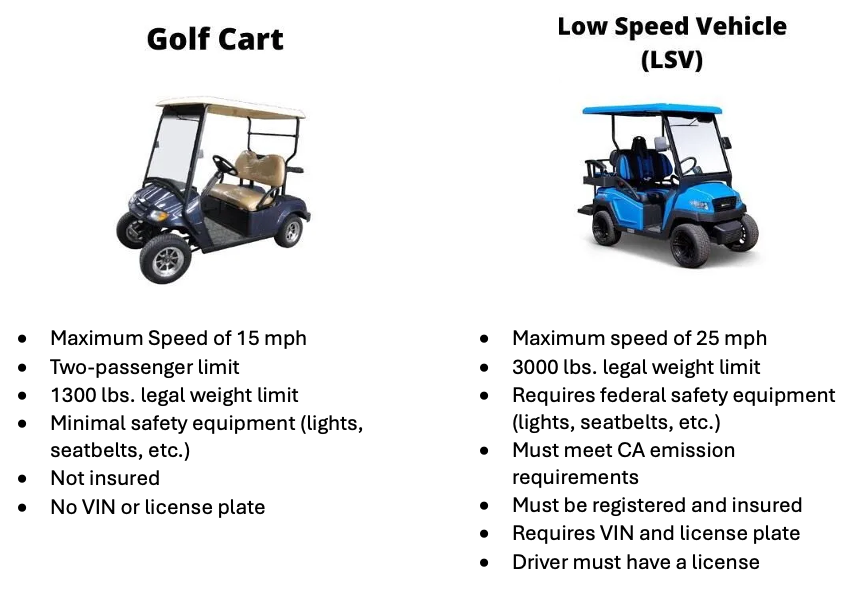
Golf carts have a maximum speed of 15 mph, a two-passenger limit, and a legal weight limit of 1,300 lbs. If required by local ordinance, all drivers must have a valid driver’s license and insurance. If a golf cart has been modified to go faster than 15 mph or can seat more than two passengers, it is no longer a golf cart and is an LSV or NEV.
LSVs and NEVs have a maximum speed of 25 mph, a legal weight limit of 3,000 pounds, must meet Federal Safety equipment (seatbelts, lights, signals, etc.) and California emissions requirements, be registered with the DMV, and drivers must have a valid driver’s license and insurance. Children under 8 years old must be in approved car seats or booster seats and sit in the back seat of the vehicle.
2. If the California Vehicle Code (CVC) allows golf carts on roads with speeds up to 25 mph and LSVs and NEVs on roads with speeds up to 35 mph, why can’t we drive on District roads with those speed limits?
Based on the recent engineering and traffic survey, only two District roads have been designated with a maximum speed of 25 mph – Pinedale Drive and Jamaica Dunes Drive. The CVC also restricts the distance a golf cart may be driven to within one mile of the golf course, if allowed by local ordinance.
3. Why are all District roads not designated as residential with 25 mph speed limits?
According to CVC section 515, a residential district is a section of road that, within a quarter of a mile, has at least 13 contiguous properties with dwelling units or business structures on one side or 16 contiguous properties on both sides of the road. Since many District roads have empty lots within quarter-mile segments, this lowers the density and prevents BVS roads from being classified as residential.
District roads that do not qualify as residential because of low density are instead classified as rural. The prima facie (default) speed on District roads is 35 mph, which is above the golf cart speed limit. To set speed limits other than the default, the District conducts an engineering and traffic survey every seven years. The most recent survey was conducted earlier this year, and new speed limits were adopted on some roads as a result. However, not all District roads were included in the current and past studies due to cost.
4. BVS is a golf cart community, so why can’t we drive golf carts on the roads?
BVS is not a designated golf cart community. Per the Streets and Highways Code sections 1950-1961, in order to be designated as a golf cart community, Kern County would have to develop a specific golf cart transportation plan for BVS, and the Board of Supervisors would have to approve it by resolution or ordinance. The District does not have the legal authority to designate BVS as a golf cart community.
As part of the transportation plan, all roads in a designated golf cart community must have speed limits less than 25 mph as determined by an engineering and traffic survey. The recent survey only identified two roads with 25 mph speed limits.
5. Why can’t the District change the District Code to allow golf carts on its roads?
The CVC does allow golf carts on roads with a max speed of 25 mph if authorized by local ordinance. The District could pass an ordinance to allow this. However, only two roads have been designated with this speed limit, and only two sections of Bear Valley Road have been designated with the LSV and NEV maximum of 35 mph.
If the District were to adopt lower speed limits on other roads to allow golf carts, LSVs, and NEVs, it would not be able to enforce the CVC related to speed limits because the lower limits would not comply with the engineering and traffic survey findings.
6. The District can’t enforce the CVC because its roads are private, so why doesn’t the District allow golf carts or unregistered LSVs and NEVs on its roads?
The District is pursuing approval by the Kern County Board of Supervisors to enforce the CVC on its roads. The Board of Supervisors is scheduled to consider this on September 1, 2026. If approved, the District will enforce the CVC, including speed limits. The roads with speed limits more than 35 mph, which have been determined by traffic surveys and engineering studies, exceed the CVC maximum for golf carts, LSVs, and NEVs.
If the County does not approve enforcing the CVC on District roads, the CSD Board could consider adopting lower speed limits on all or some of the roads and, potentially, allow golf carts, LSVs, and NEVs on the roads near the golf course. However, the Police Department would not be able to issue motor vehicle speed violations on District roads and could only issue administrative citations.
7. If the District Code does not allow golf carts, LSVs, and NEVs on its roads, can’t they be driven on the side of the road and not in the traffic lane?
District Code section 4-1-2-B states that “No person may operate a motor vehicle upon district-owned property or rights-of-way which are not designated as a road without express written permission of the district.”
8. Why did the District decide to begin enforcing the code now when it hasn’t before?
The District determined that it was in the best interest of the community to enforce the District Code related to golf carts and unregistered vehicles on its roads for safety reasons and to reduce liability. Allowing these vehicles on District roads is concerning because they can be modified to go faster than 25 mph.
The common misperception is that, because these vehicles travel at a slower speed than a traditional automobile, they are safer. These are still motorized vehicles that travel at speeds that can cause serious injuries in an accident.
- According to the Consumer Product Safety Commission, there were 147,696 golf cart-related injuries between 2008 and 2018.
- The National Electronic Injury Surveillance System reports an estimated 13,000 golf cart-related accidents on roads and streets each year in the US.
- Golf cart-related accidents on roads result in an average of 40% more severe injuries than those that occur on golf courses.
- Accidents involving young passengers often result in traumatic brain injuries.
- Many accidents happen in planned communities and resort areas where the vehicles are more often used as a common mode of transportation.
- Lack of safety features and structural protection can make sharing the road with traditional automobiles a greater risk for golf carts, LSVs, and NEVs.
- Because these vehicles can weigh between 1,300 and 3,000 lbs., a collision with a pedestrian, bicyclist, or equestrian can cause catastrophic injuries.